Water Quality
How Nitrite Nearly Wiped Out Our Catfish Fry: Lessons from Starting a New RAS
Jentan’s first-hand account of a serious nitrite spike in a newly commissioned RAS, the role of salt and fresh water, the source-water treatment problems that complicated the response, and how the biofilter eventually matured.
By Jentan Hatchery Team · Published · Updated · 8 min read
- Location
- Ozubulu, Anambra State, Nigeria
- Species
- Catfish
- Fish stage
- Newly hatched fry
- System
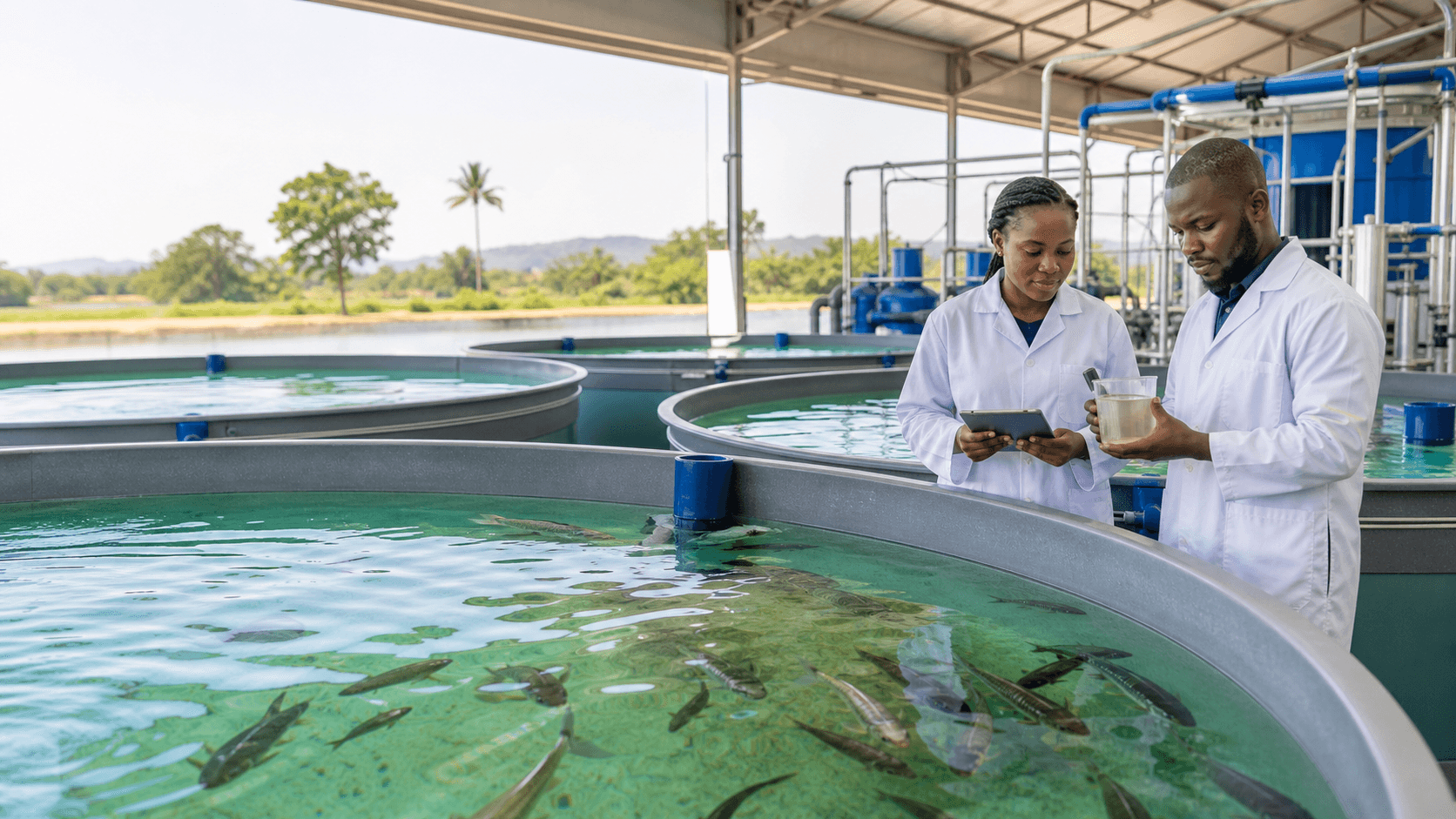
- Newly commissioned RAS hatchery
- Problem
- High nitrite
- Equipment
- RAS biofilters, circulation pumps, aeration, water-testing equipment, borehole treatment cylinder and plastic treatment system
- Outcome
- The RAS stabilised as nitrifying bacteria naturally colonised the biofilter over roughly four weeks and source-water treatment was reconfigured.
Recorded readings
Early nitrite reading: approximately 0.2 mg/L. Later nitrite reading after intervention and continued stabilisation: approximately 0.02 mg/L. Nitrate during the early period: approximately 5 mg/L. Untreated borehole baseline recorded separately: pH 5.84; alkalinity approximately 43.2 mg/L; iron approximately 0.365 mg/L.
Starting a new Recirculating Aquaculture System can create a misleading sense of readiness. Tanks may be installed, pumps running, aeration working and water circulating normally, while one of the most important parts of the system remains largely invisible: the microbial community responsible for biological filtration.
At Jentan Fish Hatchery & Farms Limited, we learned this during the commissioning and early operation of our catfish hatchery in Ozubulu, Anambra State. The RAS appeared mechanically ready for production, but its biological filtration had not fully matured. As we began producing catfish fry, nitrite became a serious water-quality problem.
The episode contributed to substantial fry losses and forced us to rethink how we commission a new RAS, manage source water and prepare biological filtration before introducing highly vulnerable fish. This is what happened, how we responded and what other farmers can learn from the experience.
A new RAS is not necessarily a mature RAS
Mechanical completion and biological maturity are two different things. A new system can have functioning pumps, filters, aeration, plumbing and tanks and still lack an adequately established biological filter. That distinction was critical for us because we were producing newly hatched catfish fry.
Fish waste, uneaten feed and organic matter introduce nitrogenous compounds into the system. In a functioning RAS, beneficial microorganisms drive nitrification: ammonia is converted to nitrite, and nitrite is then converted to the generally less toxic nitrate. In a new system, the necessary populations of nitrifying bacteria may not yet be sufficiently established.
Our RAS was effectively going through biological maturation while fish were already being produced inside it.
The warning: nitrite began to rise
During the early production cycle, we detected elevated nitrite in the hatchery water. This was especially concerning because newly hatched fry have little physiological margin for poor water quality. Conditions that larger fish might tolerate temporarily can become serious very quickly for fry.
Our objective was not simply to reduce a test reading. We needed to protect the fish while giving the biological filtration system enough time to establish itself, so we adopted several measures at the same time.
Our first response: salt
One of our immediate interventions was salt. Salt does not remove nitrite from a RAS. The chloride supplied by salt can, however, reduce nitrite uptake across the fish’s gills and therefore reduce its toxic effect. We used it as a protective intervention, not as a long-term substitute for biological filtration.
In our early monitoring, nitrite had been around 0.2 mg/L and later fell to about 0.02 mg/L after intervention and continued system stabilisation. The lesson for us was clear: salt can buy time, but the underlying biological problem still has to be solved.
Increasing fresh-water intake
We also increased the introduction of fresh water. Water exchange can dilute accumulated nitrogen compounds and temporarily lower their concentration, which can be valuable when a biofilter is immature. But increasing fresh-water intake exposed another weakness in our system: the incoming borehole water itself required treatment.
Our source water was acidic, and the initial water-treatment configuration was not performing as effectively as expected. Increasing replacement-water volume therefore had to be balanced against the quality of that replacement water. We were dealing with two connected problems at once: an immature biofilter inside the RAS and inadequate treatment of the source water entering it.
When the water-treatment plant compounded the problem
Our original treatment arrangement included a plastic-tank treatment system intended to condition borehole water before it entered the hatchery. The results were not satisfactory, so we added a cylinder-type treatment plant. Initially, water flowed from the borehole through the cylinder unit, to the overhead tank, through the plastic treatment system and then into the hatchery.
Despite having two treatment components, the water quality was still not improving to the level we wanted. That produced an important operational lesson: installing more treatment equipment does not necessarily mean the water is being treated effectively. Configuration matters.
We eventually repositioned the cylinder treatment unit toward the end of the treatment line, immediately before treated water entered the hatchery. The improvement was significant. This made fresh-water exchange a much more useful part of our water-management strategy because the replacement water itself had become more suitable.
Searching for nitrifying bacteria
While managing the immediate nitrite problem, we looked for a faster way to establish the biofilter. Commercially prepared nitrifying bacteria appeared to be the obvious solution because they can be used to seed biological filtration media and potentially accelerate establishment.
The difficulty was availability. Obtaining a suitable product locally proved difficult, so arrangements were made to source nitrifying bacteria from abroad. What appeared to be a simple procurement exercise became a logistical challenge and took approximately one month.
For an operating hatchery facing a water-quality problem, four weeks is a long time. We could not suspend the biological processes inside the RAS while waiting for a product to arrive. During that period, the system itself continued to change.
Nature eventually colonised the biofilter
Naturally occurring microorganisms gradually colonised the biological filtration media. At first, the system’s ability to process nitrogenous waste was inadequate. As the microbial population developed, however, the biofilter became progressively more effective.
After approximately four weeks, we observed that the RAS was becoming considerably more stable. The nitrifying bacteria we had been trying to import had effectively established themselves naturally within the system. The biofilter had not been defective; it had been immature and needed time and suitable conditions for the microbial community to develop.
What we would do differently
If we were commissioning the same RAS again, we would treat biofilter maturation as part of commissioning rather than regarding commissioning as complete once the mechanical and electrical systems were operational.
Before introducing large numbers of vulnerable fry, we would establish and monitor the nitrogen cycle and confirm that the biological filtration system could process the expected waste load. We would also verify the complete source-water treatment train under realistic flow conditions before relying heavily on fresh-water exchange.
Commercial nitrifying bacteria may accelerate the process, but we would not build the entire commissioning plan around the assumption that an imported product will arrive exactly when required. A hatchery needs contingency options.
Five lessons we took from the experience
- A new RAS must be biologically commissioned, not only mechanically commissioned. Clear water and running pumps do not prove that a biofilter is mature.
- Newly hatched fry leave little room for error. Routine testing should detect problems before abnormal behaviour or mortality becomes the first warning.
- Salt can help manage nitrite toxicity, but it does not replace biological filtration.
- Fresh-water exchange only helps when the replacement water is suitable. Poor source water can simply exchange one problem for another.
- Biofilters require time to mature. Our system showed significant natural biological development over roughly four weeks, although the timing will vary with temperature, pH, alkalinity, oxygen, loading and system design.
Why we are sharing our setback
Commercial farms naturally prefer to talk about successful hatches, fast-growing fish and large harvests. Those are only part of fish farming. The early months of a new hatchery can expose weaknesses that were difficult to identify during design and construction. At Jentan, those early months included power challenges, source-water problems, treatment-system adjustments and the maturation of a completely new RAS.
Some of those problems were expensive, but they were also educational. The nitrite episode changed how we think about RAS commissioning. We now regard the biological ecosystem inside the filtration system as infrastructure in its own right: pumps can be installed, tanks can be built and filters can be connected, but a functioning biological ecosystem must also be established, monitored and protected.
The bigger lesson for new RAS operators
RAS technology offers substantial advantages for intensive aquaculture, but it creates dependence on interconnected systems. Water circulation, aeration, biological filtration, source-water treatment, power supply and monitoring cannot be treated as completely separate components. A failure in one area can quickly affect another.
Our experience demonstrated that clearly. An immature biofilter created the initial problem. Fresh-water exchange became part of the response. That response exposed deficiencies in source-water treatment. Difficulty obtaining nitrifying bacteria prolonged uncertainty. Ultimately, natural bacterial colonisation and improvements to the treatment arrangement helped stabilise the system.
For anyone establishing a new RAS hatchery, our central lesson is simple: do not assume that a newly completed RAS is ready for full production simply because the equipment is running. Make sure the system is biologically ready for the fish you intend to put into it.
Educational note
This article describes Jentan’s operational experience and is provided for educational purposes. Water chemistry, stocking density, system design and fish condition vary between farms. Interventions involving salinity, water exchange, chemical treatment or biofilter management should be based on appropriate water testing and the requirements of the species and production system concerned.
About Jentan Hatchery Team
Water Quality & RAS Operations
Field notes from the Jentan Fish Hatchery & Farms operations team in Ozubulu, Anambra State, documenting real production challenges, corrective actions and lessons for other fish farmers.